USD Assembly Authoring
This authoring lane turns CAD geometry and PLM product definition into a USD master archive. The output is structured for reuse, deterministic regeneration, and downstream ingestion across DCCs and real-time pipelines.
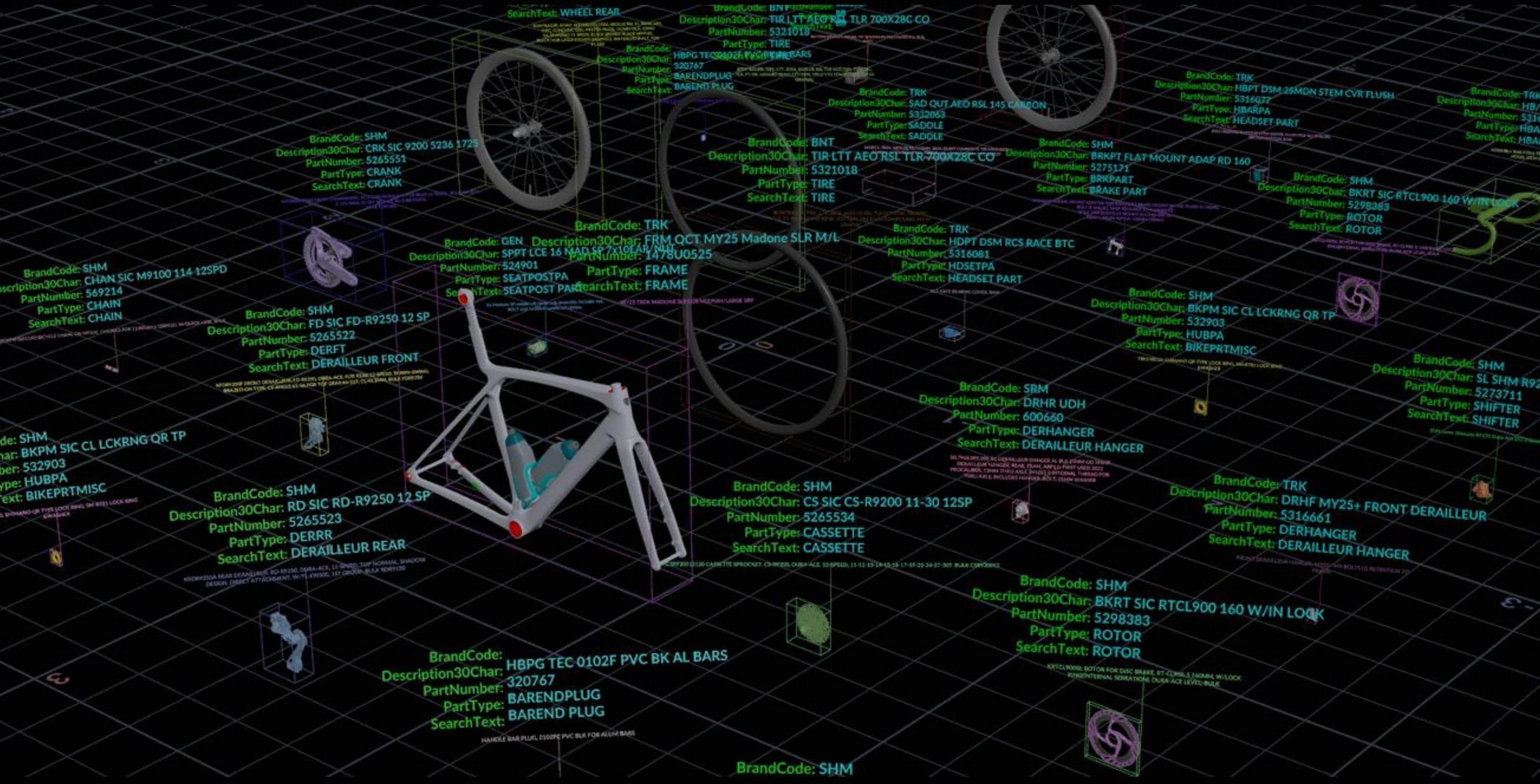
Overview
Most CAD exports stop at "a pile of geometry." This system authors USD assemblies that behave like a product definition container: clean structure, stable identifiers, and composition patterns that survive revisions.
- Production-first structure: assemblies are rebuilt deterministically to fit production needs, not mirrored 1:1 from CAD, driven by PLM identity and relationships.
- Composition for reuse: assemblies reference a catalog of components to avoid duplication and keep rebuilds scalable.
- Product definition container: USD carries geometry plus PLM-derived identity and business context in a single, queryable package.
- Determinism and traceability: stable prim paths and identifiers support repeatable builds and resilient downstream references across revisions.
- Programmatic control: outputs are authored for pxr API manipulation, automation, and validation hooks.
- Orchestration cohesion: authoring is integrated into the build graph, with Solaris serving as the USD-native authoring surface.
- Downstream ingestion: USD master archives are currently consumed in Cinema4D and designed for any USD-capable DCC (Unreal, Maya, and others).
The goal is simple: downstream teams should be able to ingest USD without needing to understand CAD exports, naming quirks, or revision chaos.
Authoring Model
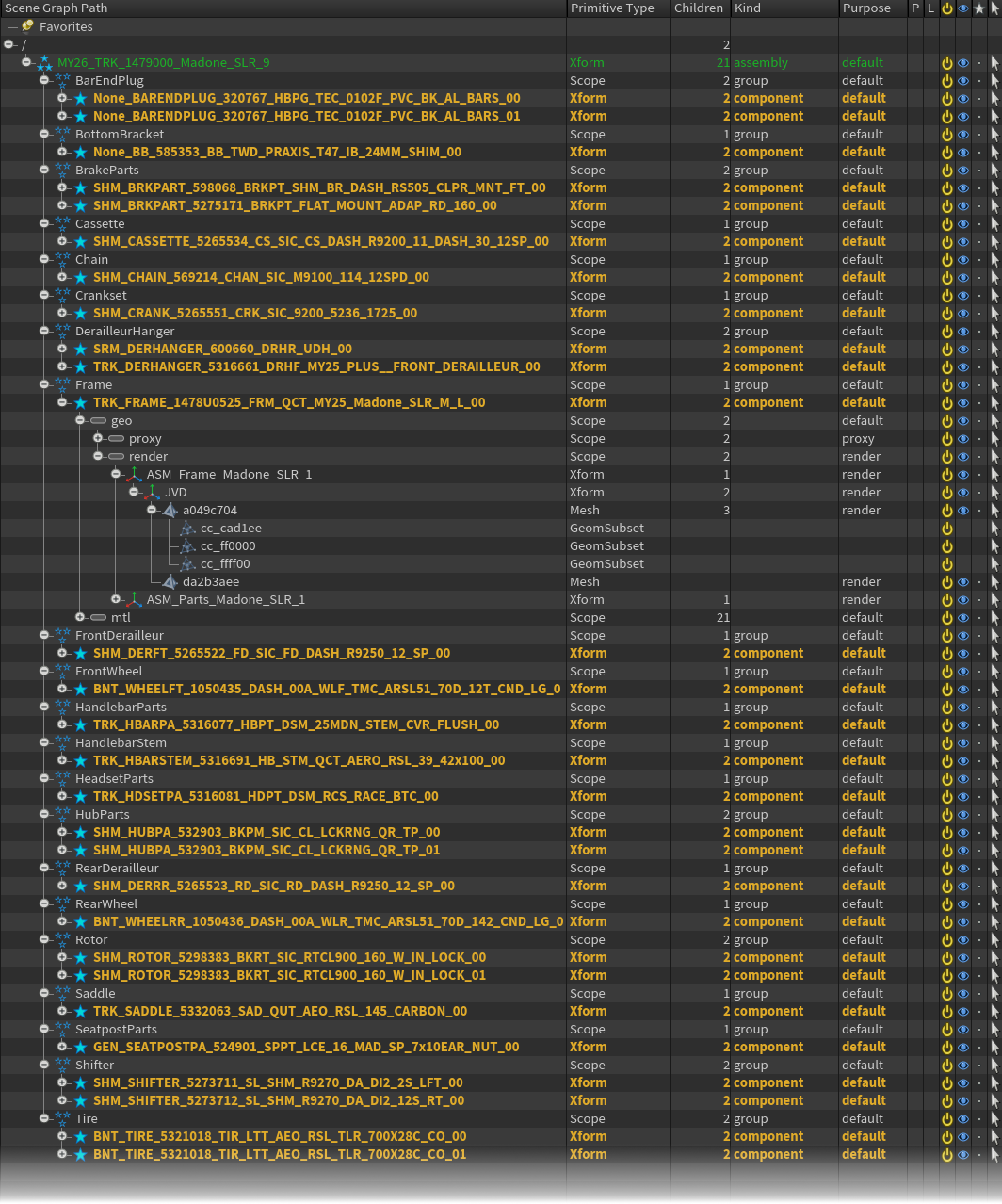
This pipeline treats USD authoring as an ETL mapping problem. CAD provides geometry, occurrence transforms, and a raw assembly graph. PLM provides identity, lifecycle, and product relationships. The authoring step normalizes both into a predictable USD structure with clear composition boundaries.
- Extract: CAD structure and transforms, geometry artifacts, and configuration pointers.
- Transform: normalize naming, map PLM identity onto assembly nodes, rebuild hierarchy for production use.
- Load: author layered USD assemblies intended as a master archive for downstream consumption.
Determinism matters. Given the same CAD and PLM state, the authored assembly rebuilds the same way every time.
Composition for Reuse
The authored assembly is designed to reuse a component catalog instead of duplicating authored data. This reduces file size, simplifies updates, and keeps rebuilds manageable as the library grows.
- Component catalog: assemblies reference component definitions to avoid redundant authoring.
- Clear data boundaries: assembly composition is separated from component geometry and metadata so each can evolve independently.
- Scalable rebuilds: changes to a component propagate cleanly without re-authoring every consuming assembly.
Downstream Consumption
Today, the master USD archives are served into Cinema4D as a pragmatic production bridge. The structure is intentionally USD-native and API-friendly, so the same archives can be ingested into other consumers that support USD.
- Current consumer: Cinema4D.
- Designed candidates: Unreal, Maya, and any USD-capable DCC with an API interface.
- Downstream contract: predictable prim paths, stable identifiers, and metadata placement that supports search and automation.
The output is authored to be consumed. If a downstream tool cannot reliably ingest it, the authoring failed.
Integration with the Build System
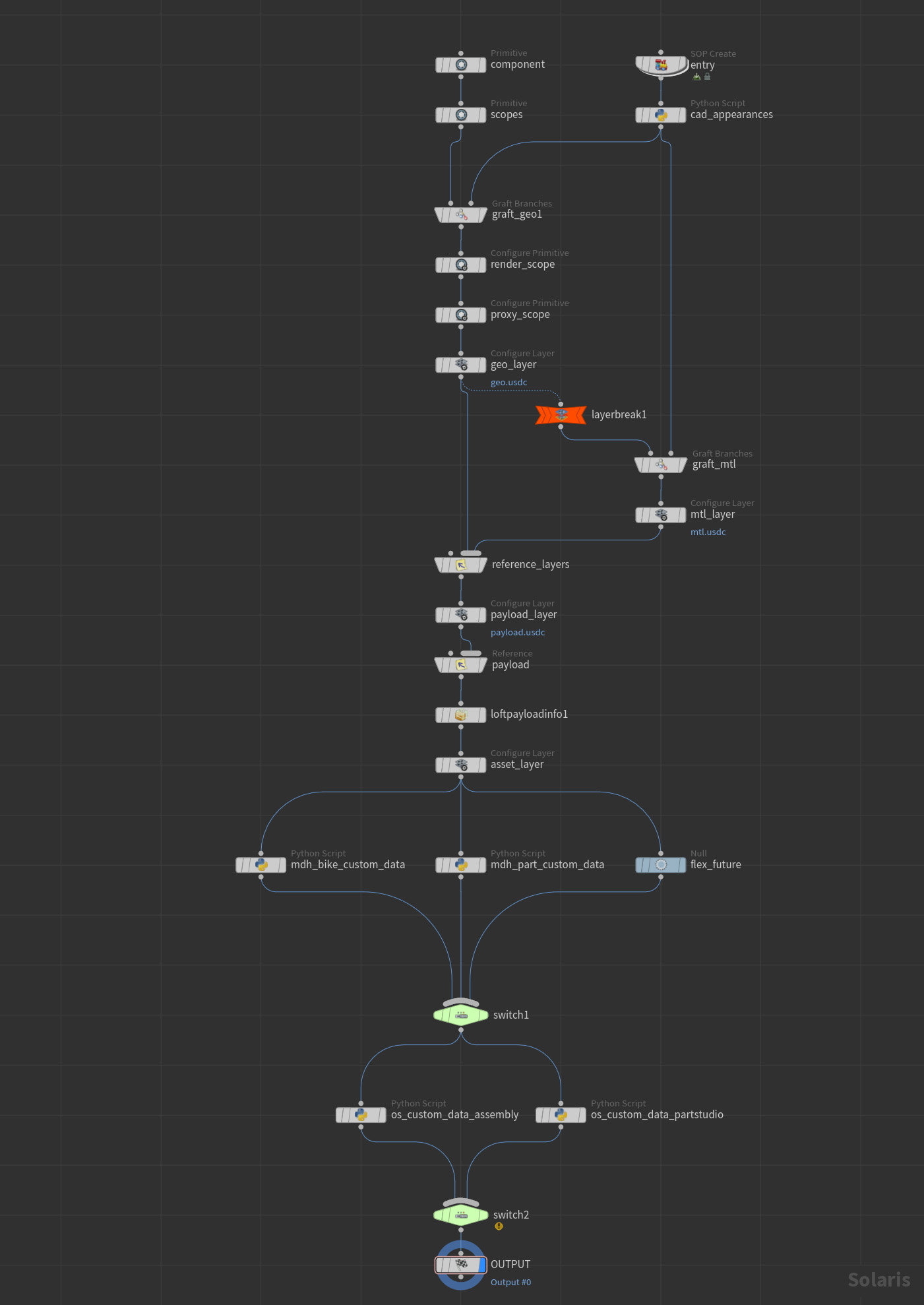
USD authoring is not a standalone script. It is integrated into the orchestration layer so assemblies are generated as part of a deterministic build graph. Solaris provides a USD-native authoring surface, while pxr APIs enable targeted edits, validation, and automation.
- Solaris cohesion: authoring happens in a USD-native context that aligns with upstream orchestration.
- pxr control surface: outputs are designed to be programmatically manipulated, inspected, and validated.
- Publish-ready archives: the final artifact is a master USD assembly intended for ingestion, not manual cleanup.
Ownership
This is a production system I own end-to-end. I built and maintain the CAD-to-USD pipeline that authors these assemblies, and I set the authoring standards used to represent product definition for Trek’s digital twin effort.
- Authoring standard: defines the assembly structure, composition patterns, and metadata contract that downstream consumers rely on.
- End-to-end responsibility: owns the lane from CAD and PLM inputs through deterministic USD publishing.
- Operational delivery: supports regeneration under constant revision pressure and maintains reliability as inputs and requirements evolve.
- Downstream readiness: ensures outputs remain ingestible and useful for production consumers, not just technically valid USD.
The goal is not a one-off export. It is a stable, reusable USD product archive that can serve as the foundation for a long-term digital twin standard.